Note from the Archivist
AAPI and Latino communities’ historical struggles for justice, liberation, and dignity have often intersected. Both groups experienced violent, racist forms of legal exclusion in the realm of immigration, albeit in different eras. Asian immigrants to America in the 19th century were framed as immoral, easily manipulated, ungovernable, and immutably foreign, and many of these same tropes have been refined and recycled to deploy against Latino communities today. On a global scale, both groups’ histories are similarly inseparable from the forces of colonialism, empire, and extractive labor. For instance, literary and cultural fusions emerged in the Philippines out of the legacy of Spanish colonialism, while in South America, forces of indenture and coercive migration produced the “Chino-Latino” diaspora. For Hispanic Heritage Month, we honor these histories of transnational struggle, as well as the localized instances of community-building, organizing, and cultural resistance that emerge from their legacy.
The ways in which Asian-Latino solidarity emerges in LHP’s collections pay particular attention to how long histories of injustice and exclusion can create robust, principled social movements and struggles. Whether in moments of multi-racial organizing or in the case of modern-day diasporic identities—in all of their hyphenated combinations—these histories strengthen each other. We strive to uplift these histories of solidarity with the knowledge that our communities have always been side-by-side in struggles for liberation: sharing meals, picket lines, community institutions, and activist spaces along the way.
You can approach teaching with LHP materials for Hispanic Heritage Month in a variety of ways!
- Centering global systems of oppression and cultural fusions: tracing systems of colonialism, extractive labor, and forced migration, and the traditions, institutions, foodways, and art that emerged in their wake
- Thinking about the place-based struggles of everyday life: communities in diaspora coming together in shared spaces and joining each other in shared struggle over issues like safe and affordable housing and culturally inclusive schools
- Through the lens of linguistic solidarity: groups coming together to create materials for mass use that prioritize language accessibility
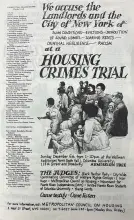
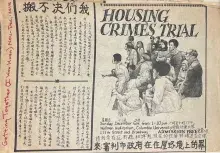
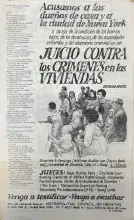
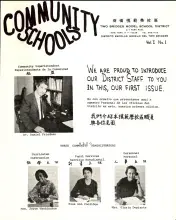
The selected list of LHP exhibits relevant to Asian-Latino solidarity approach the topic from various angles, from the intermarriage of Puerto Rican women and South Asian sailors in Harlem to I Wor Kuen and the Young Lords sharing custody of a mobile tuberculosis testing truck that had been “liberated” for community use. During the community control experiment in Two Bridges, Manhattan, parent-organizers and school advocates created trilingual materials in English, Spanish, and Chinese, while young people and student-organizers in groups like the Black Panthers, Young Lords, and I Wor Kuen brought the same concern for language access to the public materials created to accompany the Housing Crimes Trials in the 1970s.
Featured Exhibits











Monthly Archival Spotlight
Housing crimes trial - translations in English, Chinese, Spanish
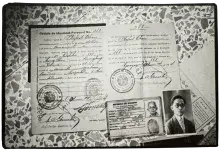
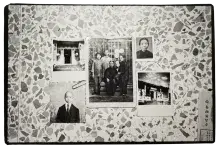
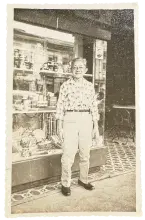
Clarissa family photos
Parent organizing in Two Bridges - trilingual materials
External resources
- Podcast: #1444 – Hyphen-Americans
- The Latinos of Asia: How Filipino Americans Break the Rules of Race — Anthony Christian Ocampo
- Understanding the Diverse Origins and Experiences of Asian Latinos
- Latino and Asian-American Solidarity
- Poet Barbara Jane Reyes on the Filipino-Latino Connection (Hyphen Magazine, 2014)
- A Brief History of Political Collaborations between Latinos and Asians in America (Hyphen Magazine, 2014)
- The Loneliest Americans (Jay Caspian Kang, 2021)
- The Young Lords: A Radical History (Johanna Fernández, 2020)
- Resources on The Young Lords, a MCNY exhibit
- Recalling a Forgotten History of South Asians in East Harlem (Sofia Ahmed, Brown History, 2022)
- The Chinese in Mexico, 1882-1940 (Robert Chao Romero, 2010)
- From Slavery to Freedom: Chinese Coolies on the Sugar Plantations of Nineteenth Century Cuba (Evelyn Hu-DeHart, Labour History, 2017)
- Chinese Cubans: A Transnational History (Kathleen López, 2013)
- Afro Asia: Revolutionary Political and Cultural Connections between African Americans and Asian Americans (eds. Fred Ho and Bill Mullen, 2008)
- Asian Diasporas in Latin America and the Caribbean: An Historical Overview (Evelyn Hu-DeHart and Kathleen López, Afro-Hispanic Review, 2008)
- Remembering the Manongs and Story of the Filipino Farm Worker Movement (Dennis Arguelles, National Parks Conservation Association Blog, 2017)
- Labor & Activism of Filipino Farmworkers (Foundations & Futures Module)
- Rising Up from the Fields (How Can You Forget Me: Filipino American Stories, a series from the Smithsonian National Museum of American History, 2026)