Note from the Archivist
This November is Native American Heritage Month, and LHP honors land, place, and space in all of the various forms they take in our archive. This month’s theme offers us a chance to think about big, structural questions — gentrification and cycles of displacement, labor and land, colonialism and empire — but also of the emotions tied to place, and how those appear in the archive.
Land, and the forced removal of people from it, is one of history’s enduring issues. This process of displacement and dispossession, often violently enforced, often appears as a historical rupture: people were once here, and now others have assumed their place. In the process, their connections to ancestral land, language, culture, histories, and sites of significance are disrupted.
It can be complicated to fit centuries-old processes of displacement into categories of modern language. Many contemporary activists and organizers find power in naming “gentrification as the modern colonialism.” This parallel is primarily used to emphasize the violence and indignity inherent to pushing communities of color out of the neighborhoods that they call home, as groups like Chinatown Art Brigade or CAAAV in Manhattan’s Chinatown have been advocating against for years. The slogan is often a staple on banners at anti-gentrification and pro-tenant protests throughout New York City. How can it be complicated — not negated — when we place it within a longer history of indigenous displacement from Lenapehoking? And how do we make sense of the fact that land can be home to many different communities over time, each with different material, emotional, and historical claims to it?
This month, we think through these questions alongside scholars of Asian American Studies who have laid the groundwork for scholarly conversations about settler colonialism and place-making. Ronald Takaki, for instance, considers the history of indentured and migrant Asian laborers on sugar plantations in Hawai'i and the Caribbean to be the origin point of Asian America. Francisco Delgado writes about diaspora and distance, thinking about the relationality and interconnectedness that could be built across North American, Pacific Islander, and Asian indigenous communities. And Nishant Upadhyay, our featured November scholar, writes of the obligation of the Asian diaspora to recognize our existence as “Indians on Indian land.”
We’re lucky to have a wide variety of exhibits in our archive that dive into the complexity of these questions, both from LHP’s brilliant Youth Researchers and our fabulous community partners. The selected LHP exhibits approach the topic of land and place from various angles, from thinking through the memories carried in music across oceans and forced migrations, to questioning what it means to be a “naturalized citizen” on stolen land. Some assert their belonging through art, activism, and the creation of public space, while others find strength and community in organizing to protect their elders and neighbors. In every instance, one can consider the ways in which “neighborhood identity is contested, layered, and reclaimed,” made and remade over time into the vibrant, complex city that we know today. As a Chinatown Art Brigade anti-gentrification art installation proclaims: “Chinatown, West and South Bronx, Southwest Yonkers, Crown Heights, Bushwick, our struggle is connected.”
Featured Exhibits








Monthly Archival Spotlight
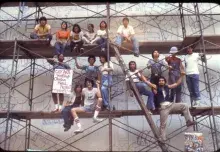
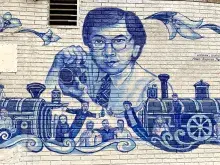
Anti-gentrification art projections by the Chinatown Art Brigade
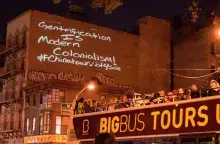
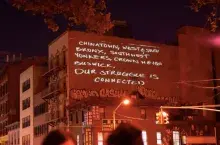
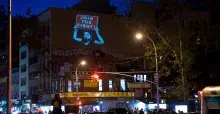
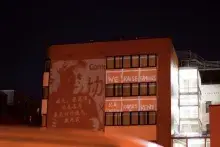
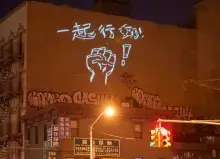
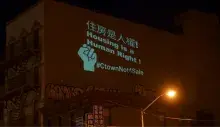
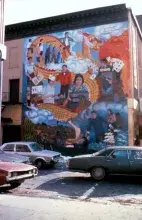
Place-based art installations in New York's Chinatown
External resources
Teaching Local Lenape History
- “Land of the Lenape: A Violent Tale of Conquest and Betrayal” (Bowery Boys, July 23, 2020): https://www.boweryboyshistory.com/2020/07/sad-tale-lenape-original-native-new-yorkers.html
- “The True Native New Yorkers Can Never Truly Reclaim Their Homeland” (Colleen Connolly, Smithsonian Magazine, October 5, 2018): https://www.smithsonianmag.com/history/true-native-new-yorkers-can-never-truly-reclaim-their-homeland-180970472/
- Lenape Talking Dictionary: https://www.talk-lenape.org/about-us
- “Native American Activism: 1960s to Present” (Lauren Cooper, Zinn Education Project): https://www.zinnedproject.org/materials/native-american-activism-1960s-to-present/
- Our History Is the Future: Standing Rock Versus the Dakota Access Pipeline, and the Long Tradition of Indigenous Resistance (Nick Estes, 2024)
- “Home in Lenapehoking” (Joe Baker and Hadrien Coumans, Urban Omnibus, February 6, 2020): https://urbanomnibus.net/2020/02/home-in-lenapehoking/
Asian Americans, Settler Colonialism, and Indigeneity
- “Distorted Footprints: A Critical Refugee Studies Podcast” (Created by students of Professor Evyn Lê Espiritu Gandhi’s “Critical Refugee Studies” course at UCLA, 2020-2023)
- From a Native Daughter: Colonialism and Sovereignty in Hawaii (Haunani-Kay Trask, 1999)
- How to Hide an Empire: A History of the Greater United States (Daniel Immerwahr, 2019)
- Dark Laboratory: On Columbus, the Caribbean, and the Origins of the Climate Crisis (Tao Leigh Goffe, 2026)
- Indians on Indian Lands: Intersections of Race, Caste, and Indigeneity (Nishant Upadhya, 2024)
- “Whose Vision?: Asian Settler Colonialism in Hawai'i,” Amerasia Journal v. 26, n.2 (Candace Fujikane and Jonathan Y. Okamura, 2000)
- “Settler Colonial Studies, Asian Diasporic Questions,” Verge: Studies in Global Asias v. 5, n.1 (Iyko Day et al, 2019)
- “Transpacific Entanglements” in Flashpoints for Asian American Studies (Yên Lê Espiritu, Lisa Lowe, and Lisa Yoneyama, 2018)
- Unsettled Solidarities: Asian and Indigenous Cross-Representations in the Américas (Quynh Nhu Le, 2019)